
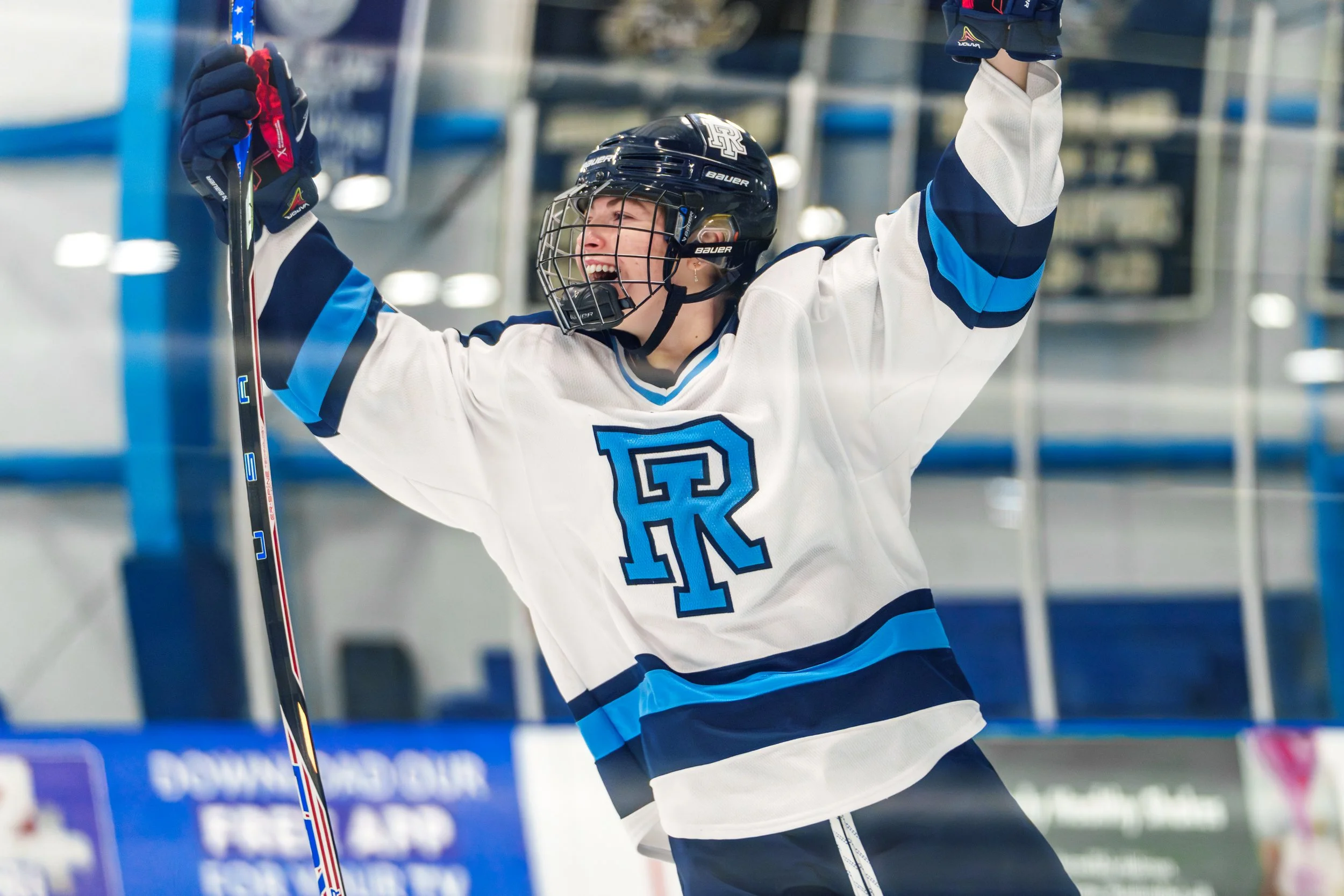
University of Rhode Island’s Neve Brierton celebrates a goal. Photo by Jay Ruzicka
Neve Brierton, a forward on the University of Rhode Island’s women’s hockey team, wants you to know that ACHA hockey is just as competitive as other college sports. “The biggest misunderstanding people have about ACHA hockey is that it isn’t truly competitive. As a women’s team, there are still stereotypes that women’s hockey is less exciting to watch. However, once you see the level of play and intensity in a game, those assumptions can change quickly.”
But what makes ACHA hockey different from NCAA hockey, and why are more and more collegiate athletes choosing it as an opportunity to play competitive hockey?
Founded in 1991 to bring structure and organization to college club hockey programs around the country, the ACHA grew throughout the 1990s as more colleges joined, giving students the opportunity to balance their love of the sport with their education. The ACHA was created to allow college students to continue playing hockey at the collegiate level outside of the NCAA. Over the past three decades, it has grown into an established part of the college hockey landscape. What began as an effort to organize college club hockey has developed into a national association representing more than 461 colleges and university-affiliated teams across 48 states and two Canadian provinces.
Women’s hockey became part of that history in 2000, when the ACHA added its first women’s division, followed by a second women’s division in 2006. Since then, generations of college players have had the opportunity to continue playing competitive hockey while pursuing their education. The organization estimates that roughly 15,000 players and coaches participate. In 2026, 84 teams and more than 1,500 players competed at the ACHA National Championships in St. Louis, playing 119 games over 11 days. The ACHA includes men’s and women’s programs competing across multiple divisions, from Men’s Division I through Division III and Women’s Divisions I and II. It has also added a developmental level designed to give additional college programs an opportunity to compete.
Although club hockey differs from NCAA hockey, it should not be confused with recreational or pickup hockey. Players in competitive ACHA leagues may have regular practices, strength and conditioning sessions, dedicated coaches and coaching staffs, playoffs, and a national championship tournament. At this point, you may be asking yourself: Why don’t these players just play for their college’s Division I or III team?
For Brierton, it comes down to balance.
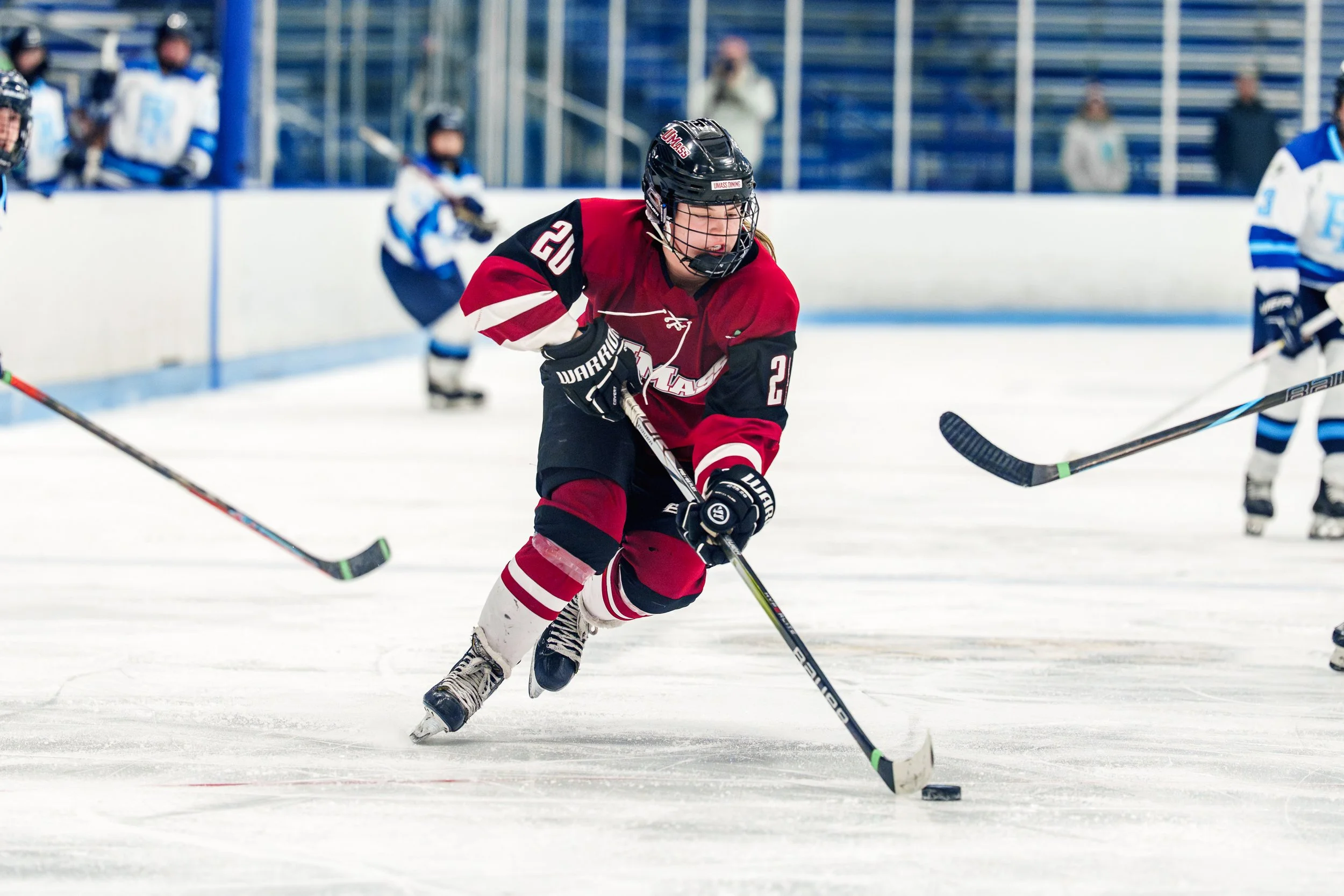
A player from UMass takes the puck down the ice. Photo by Jay Ruzicka.
“I chose to play ACHA hockey in college because hockey has always been a huge part of my life, but I also wanted the opportunity to fully invest in my major while discovering new experiences outside the rink. Playing at this level means I get to have the perfect balance of intensity and commitment while allowing me to challenge myself, explore my passions, and work towards my dreams.”
Funding is a major piece of the puzzle for any team sport, and club sports can receive financial support from a variety of sources. Speaking on behalf of URI’s team, Kiera Sweeney, a player and the team’s treasurer, explains how the program covers its expenses.
“We primarily get our funding through raising money. A portion of our funding, luckily, is allocated by Club Sports here at the University; they give us funding mostly for ice rentals, league dues, paying referees etc.”
Although URI’s team is fortunate to receive funding from the university, financial challenges remain.
“The biggest challenge with funding for our team would be the fact that we fundraise ourselves to keep our program running. Paying team dues, as well as doing cash raffles and looking for sponsorships, is not an easy thing to ask of a freshly 18 or 19 year old. We are lucky enough to be able to afford things because of the commitment from our team and coaches.”
That commitment continues to shine through despite rising costs.
“With the price of many things skyrocketing over the year, it hasn’t been an easy thing to pick and choose what funding goes to where. We are very fortunate to be able to go on three away trips this year, bussing to Michigan and flying to Colorado as well as Arizona. These things are made possible because of the dedication our team has to raising money. At the end of the day, it’s well worth asking a stranger to buy a raffle ticket if it means we get the chance to make lifelong memories together and travel to places that some normally wouldn’t.”
Keeping these clubs funded and their programs running year after year does more than allow players to balance athletics with their education. Perhaps more importantly, it helps forge lasting friendships and brings together a diverse group of athletes who share a love for the game.
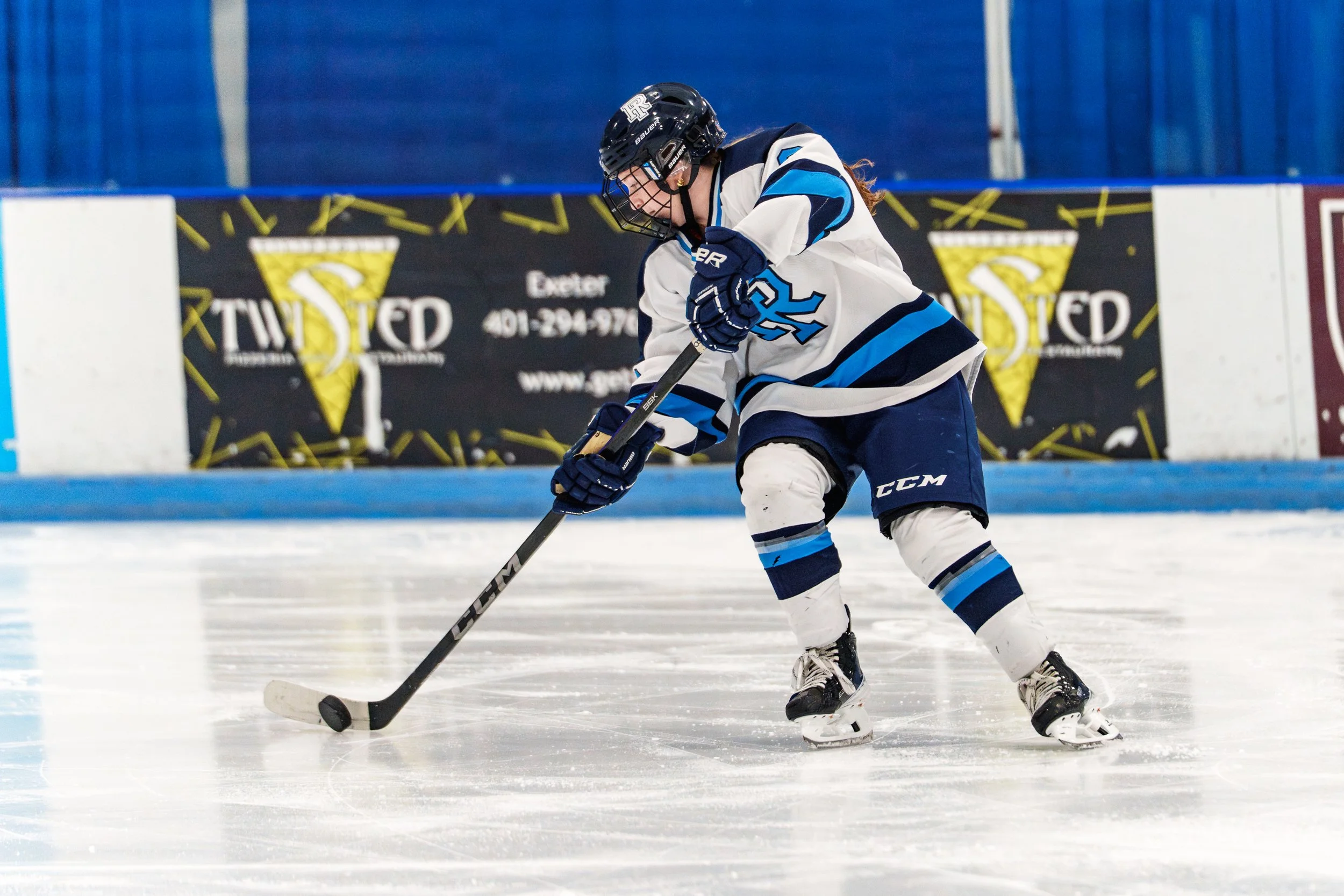
URI’s Kiera Sweeney in action. Photo by Jay Ruzicka.
“What I find most interesting about playing ACHA hockey is the variety of people and experiences that come together through the sport. Everyone comes from a different background and has their own reason for getting into hockey. Each player has different goals and a life outside of the rink, but we all share the same love for the game and are committed to competing at this level,” Brierton says.
For players like Brierton, ACHA hockey offers more than just the chance to compete. It gives college athletes the opportunity to continue playing the sport they love while building friendships, pursuing their education, and creating experiences that will last long after their time on the ice.
Written by Jacqueline Bono