
Hayley Kelleher is Reimagining Hockey Safety with Slice Guard
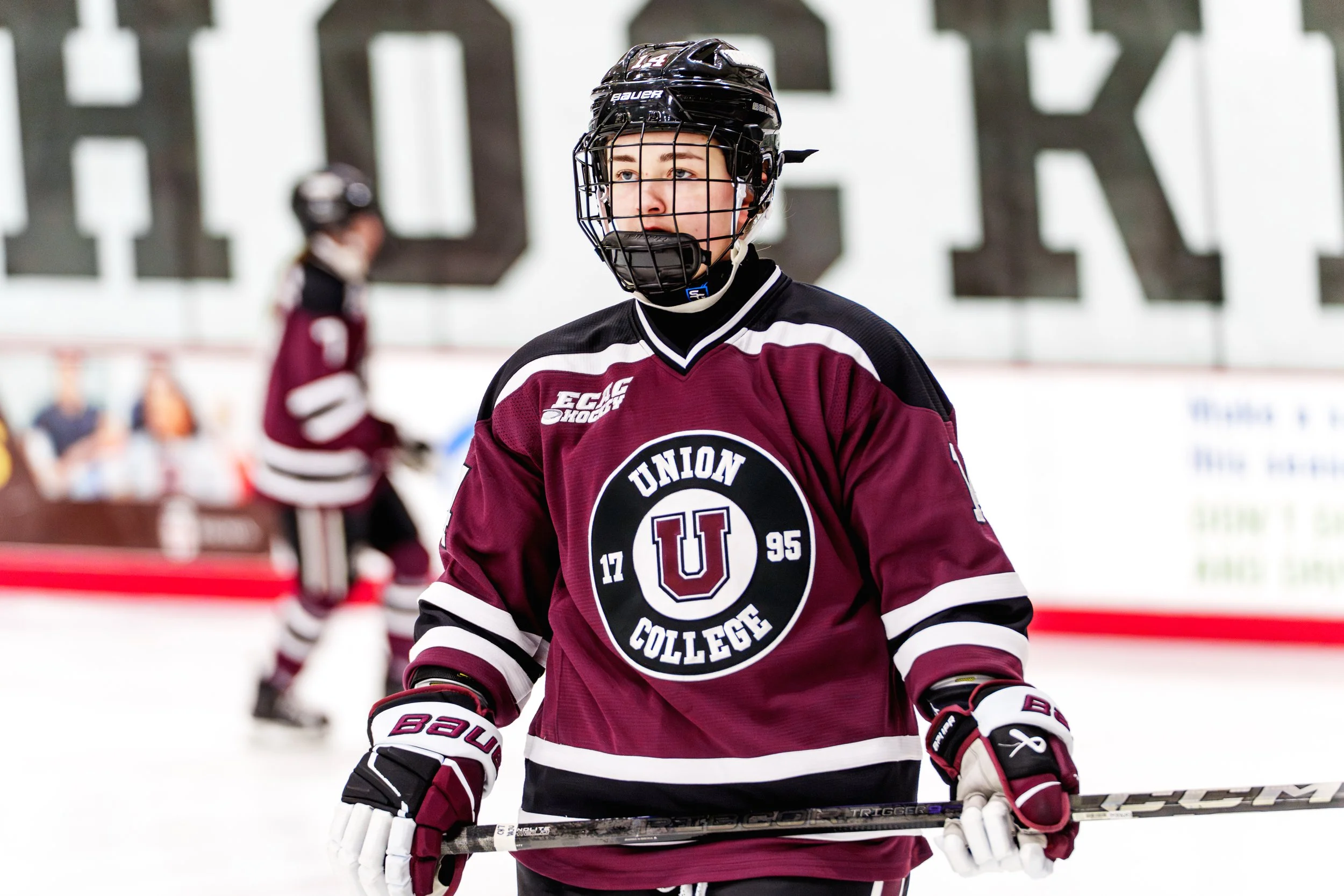
Photo by Jay Ruzicka
Hayley, thanks for joining us at Rafters Collective. Tell our readers a little about yourself.
I'm Hayley Kelleher, a rising junior forward on the Union College Women's Hockey team. I grew up in Natick, MA, dreaming of playing in the ECAC and following in the footsteps of my mom, who played at Cornell ('95). I started my college career at Clarkson University before transferring to Union as a sophomore.
I graduated from Lovell Academy in 2024, and every summer I return home to skate, train, and coach with our youth summer organization, Tropics Gold. Giving back to young players with the same dreams I once had is one of the best parts of my year.
In early 2025, I founded Slice Guard, a cut-resistant base layer for hockey players that protects both the neck and wrists. It's built around an innovative adhesion method that eliminates the biggest pain points in the current market.
Why did you start Slice Guard?
Growing up, whenever anyone asked what I wanted to be, my answer never changed: I was going to work in hockey. I'd even joke that I'd run a business that "would make me really rich." Fast forward a few years, and I've made good on at least half of that (the business part—definitely not the rich part yet).
As a first-year student at Clarkson, every business major takes an introductory entrepreneurship class where teams pitch a solution to an everyday problem. Naturally, I turned to hockey. Working alongside a few classmates from the men's program, we developed an early concept called "Neck Shield." When the class ended, the guys took their good grades and moved on, but I saw a real vision, and I'd found the strongest academic passion I'd ever had. By the second semester, I was in the advanced version of the course, doing real research and development: go-to-market strategy, prototyping, and everything that goes into actually launching a company.
That spring, each team competed in the North Country region of the New York State Business Plan Competition. With the help of my incredible mentor, Lexi Johnson, I won my category, Safety, Power, and Mobility, at regionals, advanced through a digital round and a state round, won my category again at states, and pitched for the Grand Prize. Standing on a stage in front of a 75-foot screen as a freshman gave me the validation (and the prize money) to go all in on Slice Guard.
It quickly became more than a class project. It became a mission: to take one of the most serious problems in the sport, along with its most impractical current solution, and build the product that players of every age, ability, and gender can actually wear. Because at the end of the day, the best hockey players are the ones on the ice, not in the stands with stitches in their necks or wrists.
What has been the biggest success so far?
Market validation, without question. After the tragedies of Adam Johnson and Teddy Balkind, and gruesome injuries dating all the way back to Clint Malarchuk, the question was never why this problem needs solving. It's how.
As Slice Guard approaches launch, that validation is already showing up in the excitement surrounding it. The stars of tomorrow are part of Team SG, and they're eager to finally wear Slice Guard in a game. They point to the snap adhesion method that eliminates the frustrations of Velcro, the lightweight material, and the wrist protection as the features they're most excited about. As the Chyna Taylors, Casey Mutryns, Sam Fishbones, and Sydney Stoughtons of the world wear Slice Guard over the next decade, I'm confident this will become the product everyone wants in their bag, and the interest is already reaching the collegiate and professional levels.
What continues to be the biggest challenge?
Like most startups, it's stretching every dollar to its absolute limit. Building in this space is expensive. Design and engineering, prototyping, certifications, legal work, patent attorneys... none of it comes cheap.
I'm proud of how I've competed for funding at grant events, and I look forward to continuing to earn it while preparing for the milestone every founder dreams about: finally selling units and reaching profitability.
Where do you see it going in the future?
The vision for Slice Guard is to redefine safety standards in sports and become the leading brand in performance-driven protective gear. I want to empower players at every level, across all contact sports, to compete with confidence—protected by gear that moves with them, not against them. I want Slice Guard in every locker room, no matter who's dressing in it.
I'm especially excited for Slice Guard to become a staple of the women's protective movement. Some big brands have finally taken steps toward designing products specifically for female players, and while Slice Guard isn't exclusively designed for women, it was certainly built with the ponytail in mind. Who knows—maybe that's a future product down the road.